Miao Dao
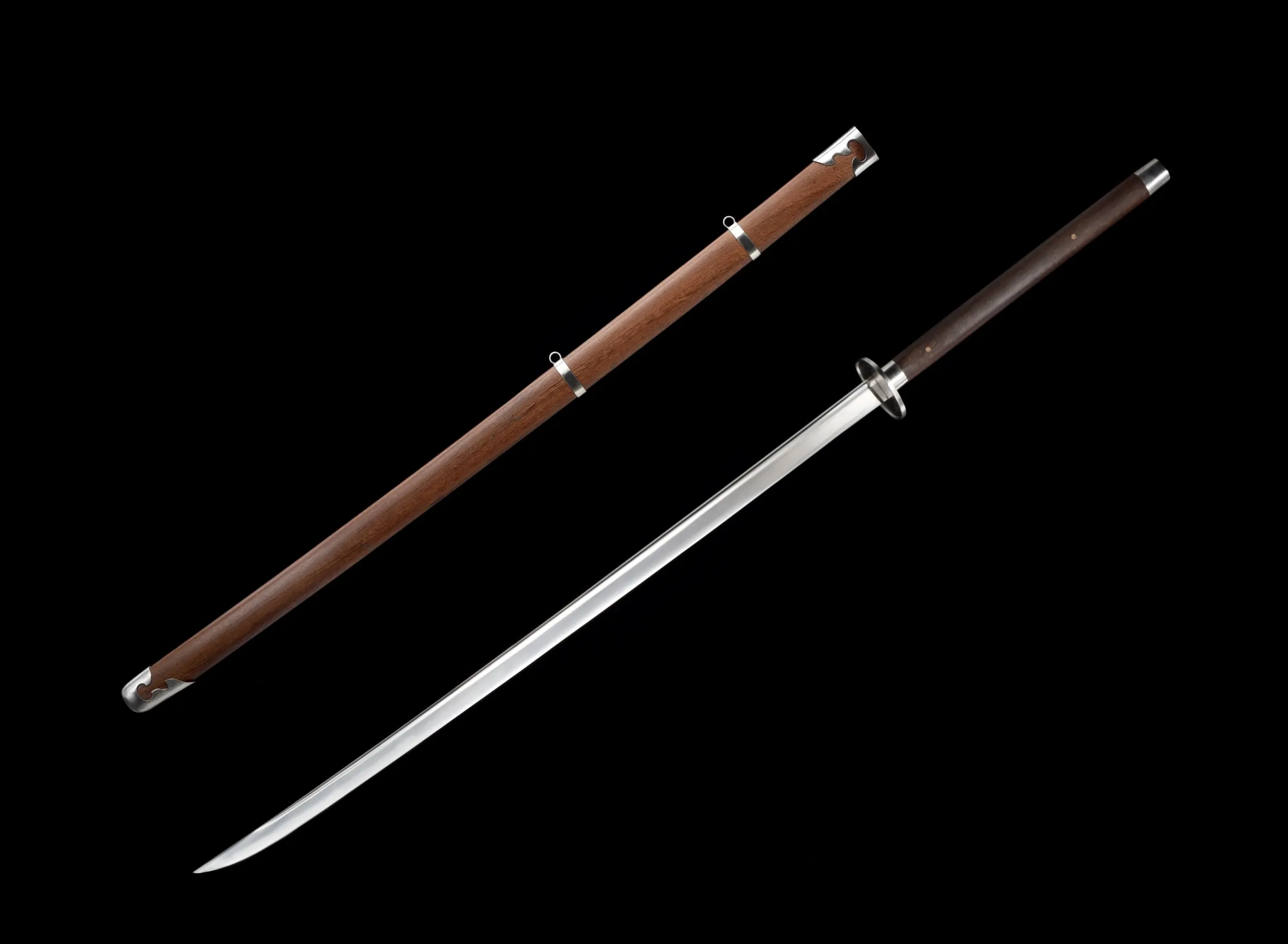
‘Silver Swallow’ by sword maker LK Chen. A re-making of the Republican Era (1919-1949) Miao Dao for martial artists.
Following on from my introductory article about some of the swords used in our school I wanted to spend a little more time on the ‘Miao Dao’, or ‘sprout sabre’.
To set the scene, first a couple of evocative pieces from ‘Wood Leopard’ from Ealing Kung Fu School in West London, UK (Facebook page). I am a novice with Miao Dao, so I cannot comment as to the correctness of the technique.
In this first one, the partitioner uses a bamboo shinai from the Japanese art of Kendo to demonstrate the form.
Now this equally well produced piece from Maling Shaolin Kung Fu Academy, China:
Having whet your appetite, how about a long and authoritative exposition on the history, development and evolution of the weapon by Matt Easton from Schola Gladitoria?
In his video below, he describes the Miao Dao as a twentieth century ‘pipe backed’ blade with a thin narrow edge. It is flexible for its (long!) length without being too wobbly. The current thinking is that the sword was influenced by the Japanese nodachi during the Ming Dynasty, leading to the development of the Chang Dao / Dan Dao swords, with a subsequent sprinkling of European influence (the pipe back), probably from the Prussians who were advising Chinese troops at the time, finally leading to the Miao Dao in the early 1900’s.
Easton references a long exposition from ‘Kung Fu Tea’ with some additional commentary on the properties of the sword…
The blade tends to be relatively broad and thin, but it emerges from a heavy T-shaped spine that is unlike anything seen on the vast majority of older blades (to say nothing of the Japanese nodachi). In practical terms the entire arrangement works very well. A broader and thin blade has great cutting characteristics, yet the pronounced “pipe backed” spine allows the weapon to be relatively rigid in the cut and thrust. Indeed, most modern miaodao are relatively straight and thrusting is an important aspect of their use and training. While obviously cousins, these are different weapons than their Ming era forebearers.
The article also references a ‘Liu Yuchan’, and I wondered for moment whether this was the founder of Wutan, Grand Master Liu Yunqiao, who seems to have a similar history and timeline…
In an effort to reimagine earlier Ming and Ching tradition, a martial artist and military trainer named Liu Yuchan introduced “miaodao troops” into the armies of the warlord (and future president of the Republic) Cao Kun. No longer concerned with defeating spearmen, soldiers armed with these long sabers, machine pistols and grenades were instead tasked with providing close support to vulnerable artillery units in Cao Kun’s army. The presence of the Japanese on Chinese territory after WWI was an extraordinarily politically volatile question and the adoption of the term miaodao rhetorically distanced the weapon from its foreign roots.
I have not been able to confirm that hunch.
To close out this already overly long article, I am including a series of videos from our Wutan cousins in New Jersey, USA. Again, I can’t comment on the content, only that I see similarities, and some differences to Wutan classes I have joined here in the UK. Note once again, the use of the shinai as a safer alternative for training over a metal edged sword.
Miao Dao 1st Route Applications
Miao Dao 2nd Route Applications
Miao Dao 3rd Route Application
Miao Dao 4th Route Application
These videos and more are thoughtfully pulled together into this playlist here.
The Miao Dao shown in Matt Easton’s video above is the Silver Swallow from LK Chen. There’s a lot of additional video material at the bottom of the product page, including some very detailed instructional content from Master Daniel Pesina, which IMHO, is worth a look.
Featured Image: Rice sprouts, licensed under BY. Unedited.
Revision History
22-Dec-2025: added picture of the Silver Swallow by LK Chen. Editing for readability.