Wutan’s Cheng Man-ch'ing Tai Chi Lineage
I was in the US for work recently and had the opportunity to visit the T’ai Chi Center in Milwaukee, Wisconsin whilst I was there. I had the chance to speak to the Founder and Head Instructor, Sifu Michael Milewski for a few minutes and the topic of lineage came up. Sifu Milewski is a second-generation student of Cheng Man-ch'ing, from Cheng’s time in New York (via Fred Lehrman?) He asked me about the lineage of our Cheng Man-ch'ing form and teaching. I remembered from our Master’ book, (Tai Chi, The Treasure of Mankind, They SoonTuan, Wutan International Martial Arts, 1997), that our lineage for this form was via Taiwan and Malaysia, but I could not remember the details.
I went back to the book and did some additional research and have sketched out the following lineage.
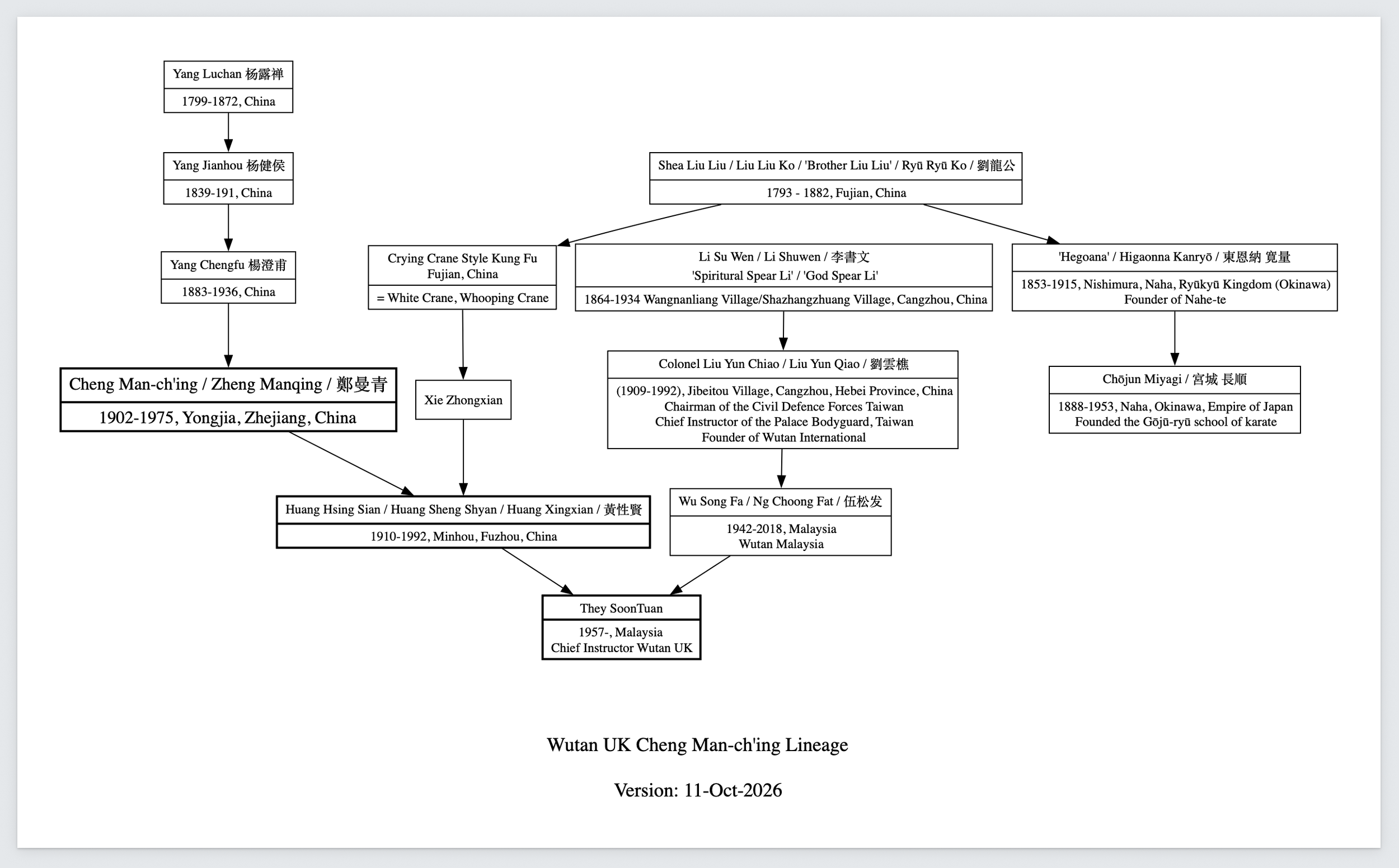
Master They is a second-generation student of Cheng Man-ch'ing, via his teacher Huang Hsing Sian in Malaysia.
Master They describes Cheng’s T'ai chi in his book…
Cheng Man Ching (25th June 1902-1975) started to practise Tai Chi at the age of 24. At the time that he commenced his practice he suffered from tuberculosis; spitting up blood and coughing uncontrollably. A little while after he started training, his illness began to improve and ultimately disappeared. This amazed him, as he himself was a famous and highly respected physician, yet he had been unable to help himself in any way prior to beginning his Tai Chi practice. However, when he ceased to practise, thinking himself completely cured, the illness reappeared. He then knew how important it was to take Tai Chi Chuan seriously. Cheng Man Ching not only attained a high level as a practitioner of Tai Chi Chuan, he was also recognised as an expert in calligraphy, poetry, painting and medicine. He was subsequently honoured as the "Master of Five Excellences". He shortened the Yang style Tai Chi set by taking out many of the repetitious movements and instead placing more emphasis on the concept of "Sung", a crude translation of which is "relaxing", a concept which contributed to the flowing nature of the shortened Yang set.
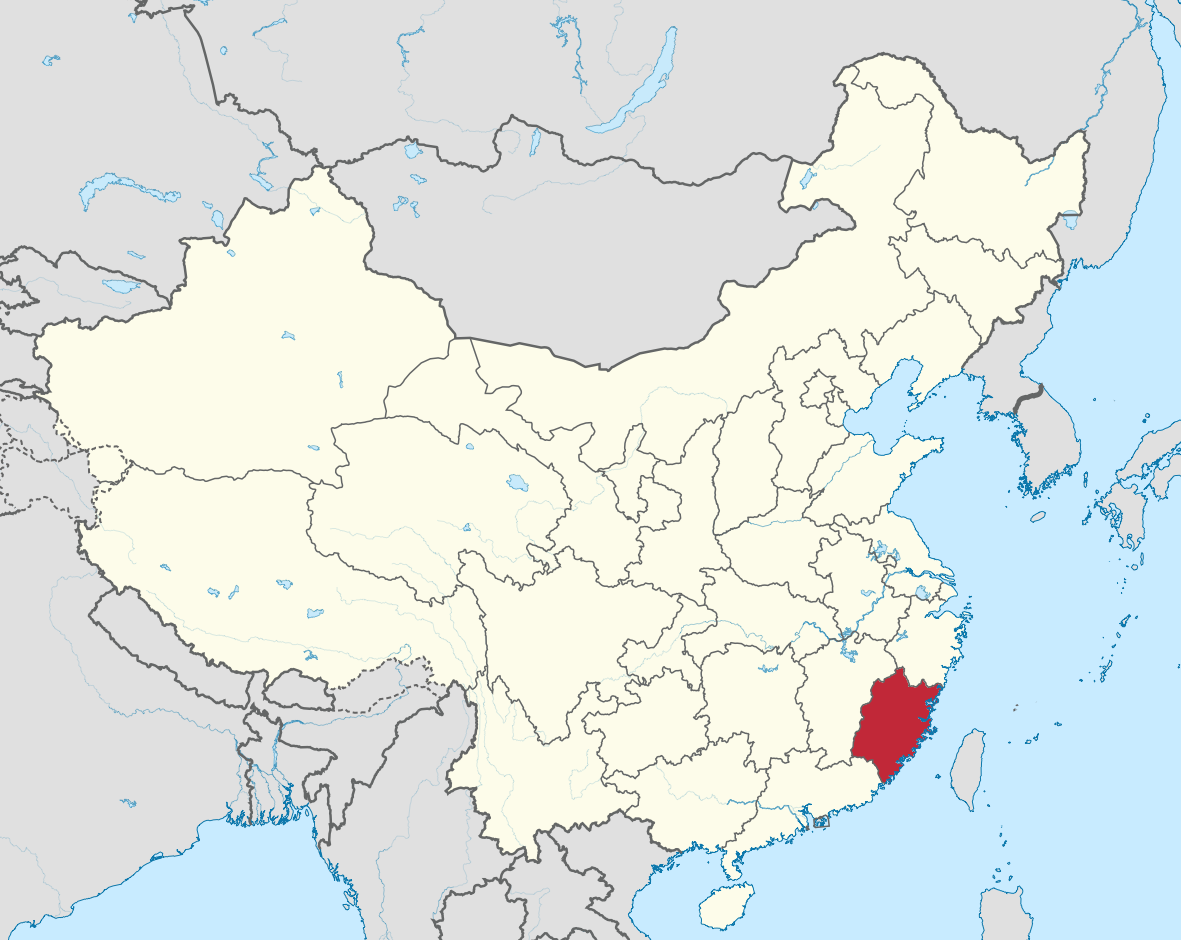
Fujian Province, People's Republic of China, where the Hokkien language is spoken. Birthplace of Huang Hsing Sian and home of White / Crying Crane Kung Fu.
He goes on to say…
In my homeland of Malaysia most people who practise Tai Chi are influenced by his style. It was introduced here by his most talented first disciple: Huang Hsing Sian. Huang Hsing Sian was born in 1910. At about the age of fifteen years, he started to study a system of martial arts that was created in Hokkien Province. It was known as the Crying Crane style of Kung Fu under Shea Liu Liu ( also known as Liu Liu Ko or brother Liu Liu - the same teacher of Hegoana, who later went on to become the founder of the style known as Goju Ryu Karate.). Huang started teaching Crane style martial arts in Shanghai in 1933.
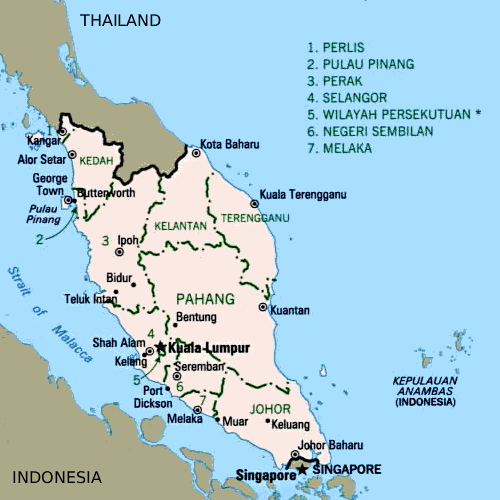
Peninsula Malaysia. Klang is about 40 minutes West South West by road from Kuala Lumpur, the capital of Malaysia, where Master They learned Cheng style t'ai chi from Huang Hsing Sian.
Wikipedia states of Huang…
He began studying Fujian White Crane with Xie Zhongxian at the age of 14. In 1947 he resettled in Taiwan where he became a disciple of Cheng Man-ch'ing.
It’s not clear whether Xie Zhongxian was a direct student of Shea Liu Liu.
And then again from Master They…
In 1972 he started teaching in Klang [editors note: about 40 minutes by road from Kuala Lumpur, the capital of Malayisa] where I was attending my secondary School. The style modified by Cheng Man Ching was known as Cheng Style Tai Chi. It was the first internal system that I began to learn. This in turn led me to further research the other internal systems such as Pa Kua and Hsing-I, as well as the other more traditional Tai Chi systems.
In turn, I learned my Cheng style from Anita Ho. I need to check whether she learned it from her teacher Derek Kent, or more directly from Wutan UK HQ and the indoor students there.
Going down the rabbit hole
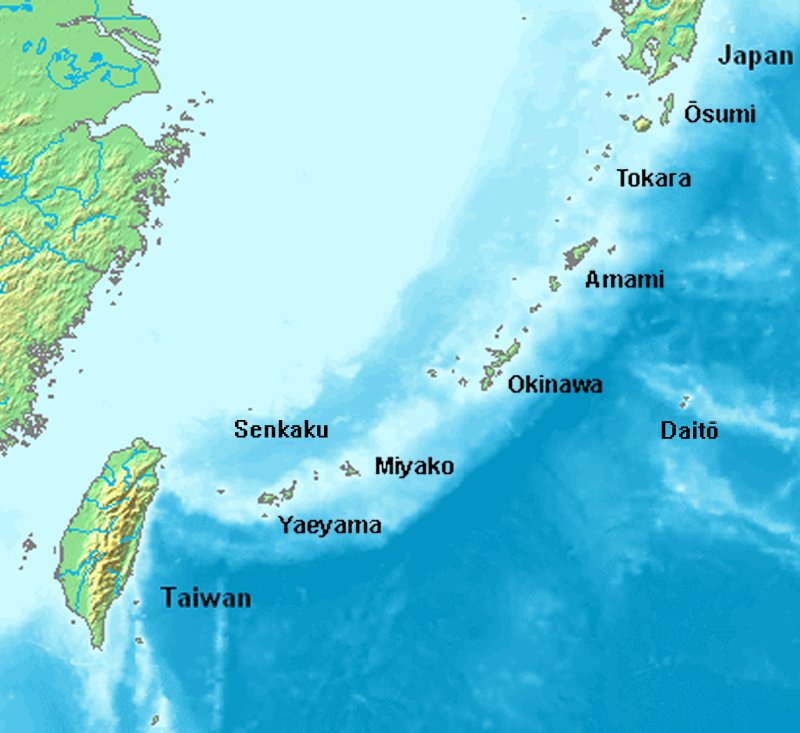
Ryukyu Islands. The largest is Okinawa. To the North of the island chain is Japan. To the West is the Republic of China (Taiwan), and further west is Fujian Province, People's Republic of China.
Before learning Cheng’s t'ai chi, Huang learned Crying (White) Crane Kung Fu. This is the style of Kung Fu that strongly influenced the Okinawan martial art of Naha-te and the Gōjū-ryū school of karate founded by Higaonna Kanryō and Chōjun Miyagi respectively.
Small world isn’t it!
Links
Additional information on Master Wu including year and place of birth from:
https://bajiquan.fandom.com/wiki/Wu_SongFa_伍松发
See also:
https://www.facebook.com/wu.songfa/
Maps
Fujian Province. By TUBS - This vector image includes elements that have been taken or adapted from this file:, CC BY-SA 3.0, https://commons.wikimedia.org/w/index.php?curid=16493591
Ryokyu Islands. By Uchinanchu - Own work, Copyrighted free use, https://commons.wikimedia.org/w/index.php?curid=901053
By The original uploader was Jpatokal at English Wikipedia. - Transferred from en.wikipedia to Commons by Totodu74 using CommonsHelper., CC BY-SA 1.0, https://commons.wikimedia.org/w/index.php?curid=7203560
Related Articles
Featured Image
Cheng Man-ch'ing. T’ai Chi Center in Milwaukee, Wisconsin. Picture taken by the author.